



The branded pharmaceutical business runs on a simple engine: discover new, patented therapeutics, earn a period of market exclusivity, and use it to fund the next discovery. The engine is sputtering. The cost of bringing a drug to market has climbed so relentlessly that the phenomenon earned its own name, “Eroom’s Law,” Moore’s Law spelled backward, capturing the fact that pharmaceutical R&D has grown less efficient over time, while nearly every other technology-driven industry has grown more so.
Roughly 90% of programs entering clinical development never reach the market, and about half of the compounds that fail in the clinic are stopped for safety or tolerability problems never caught preclinically.
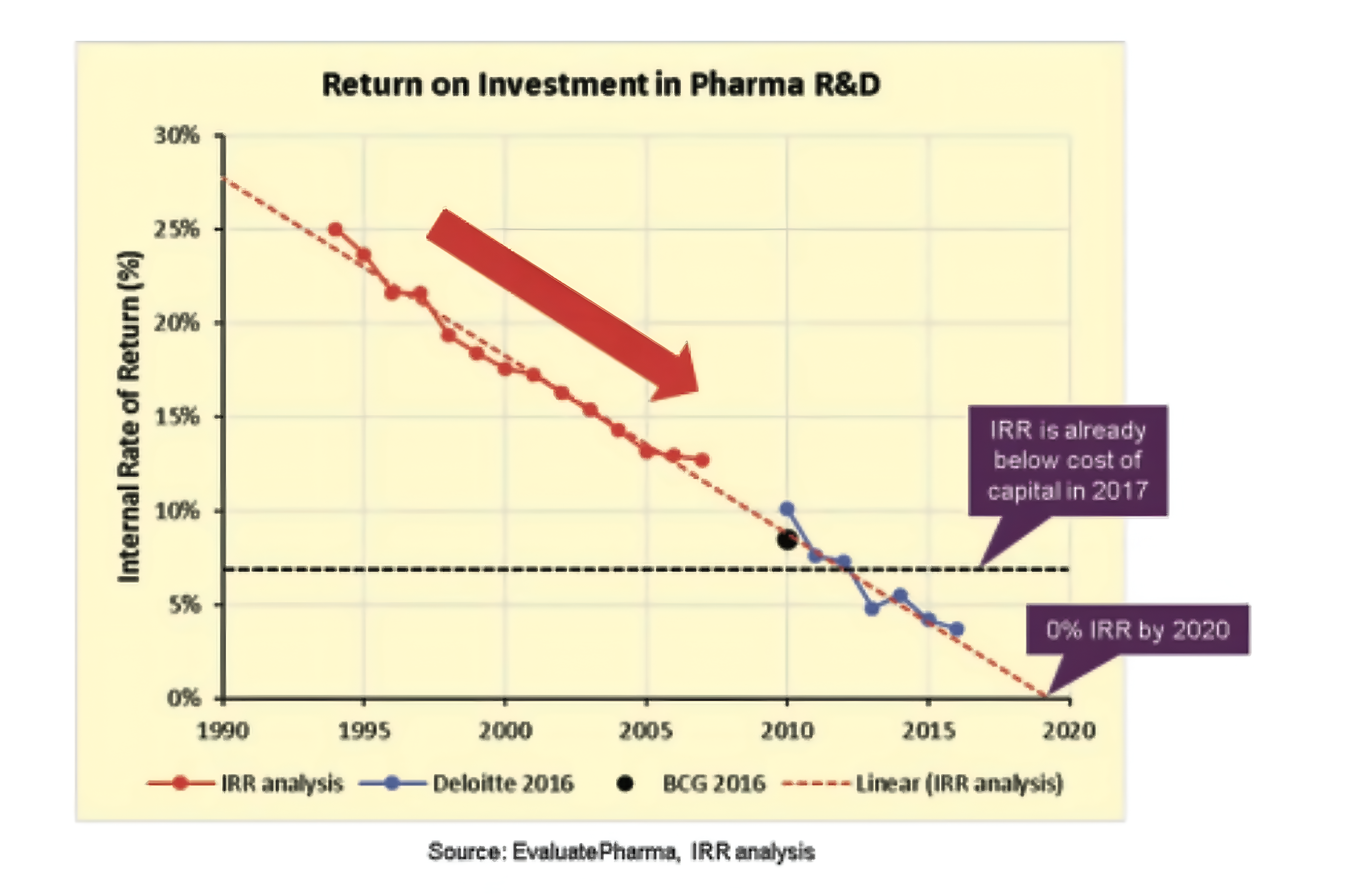
Taken from1: Reaume, A and Lipinski, C. Why an In Vivo Screening Platform Covering Broad Therapeutic Spectrum is an Ideal Tool for Drug Repositioning: Illustrated by Discovery of a Novel Class of Insulin Sensitizers. Phenotypic Drug Discovery: Chapter 12. (2021) Royal Society of Chemistry, https://doi.org/10.1039/9781839160721-00217.
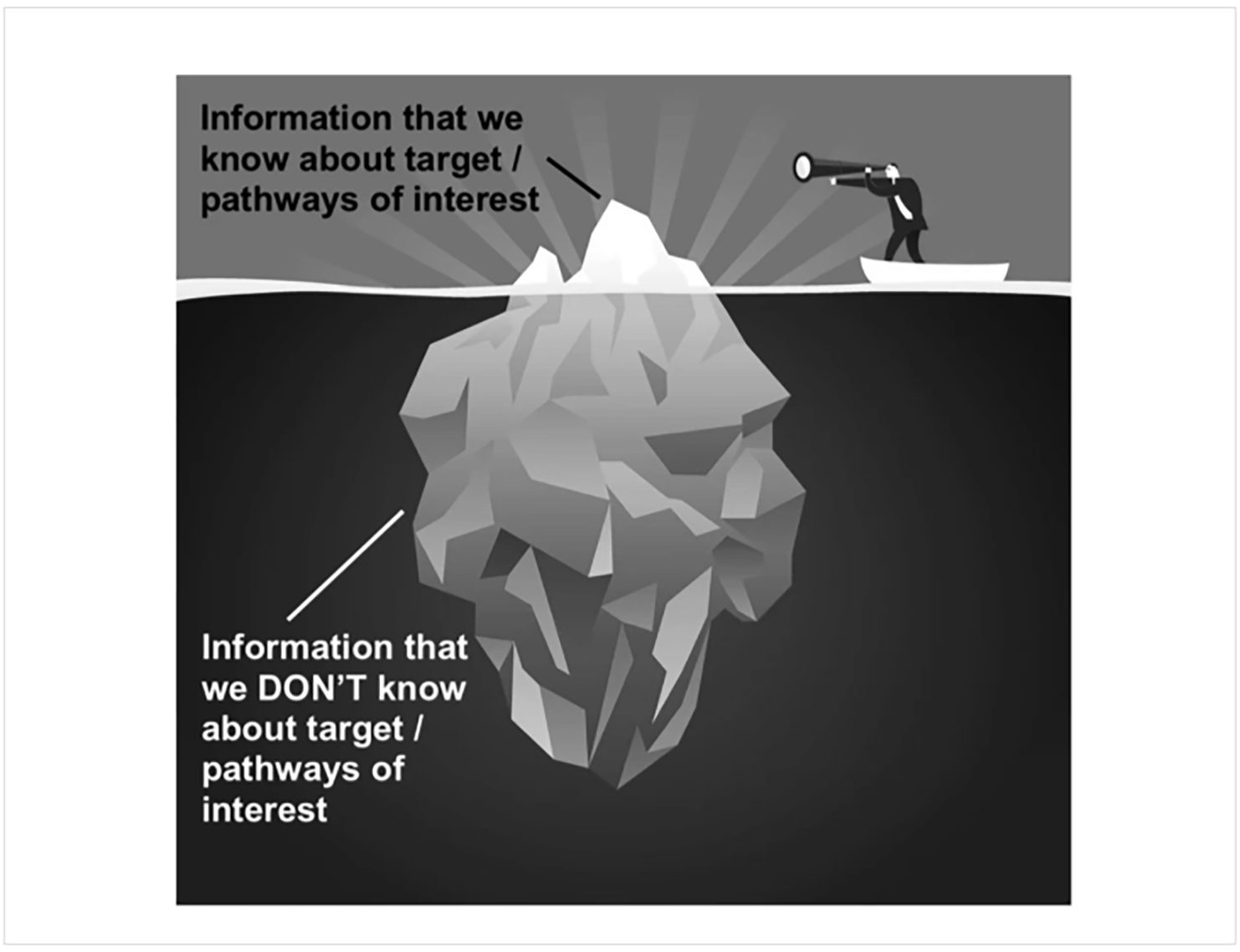
At Melior, we believe a fundamental problem that sits beneath these statistics is that there is far more complexity in biology than our current models capture.
Targets that appear well characterized are often connected to broader networks of biology and therapeutic opportunity than investigators initially appreciate. Imagine an iceberg. The biology we understand sits above the waterline; the much larger mass beneath it represents what remains unknown.
When the unknown substantially exceeds the known, drug discovery becomes constrained by the hypotheses we are capable of forming.
It is the scientific version of searching for your keys under the streetlight, not because that is where you lost them, but because that is where the light is.
The Proven Value of Phenotypic Screening and Drug Repositioning
Two discovery strategies have grown in response to this innovation gap, and Melior was built at their intersection.
Phenotypic Screening: Letting Biology Lead Discovery
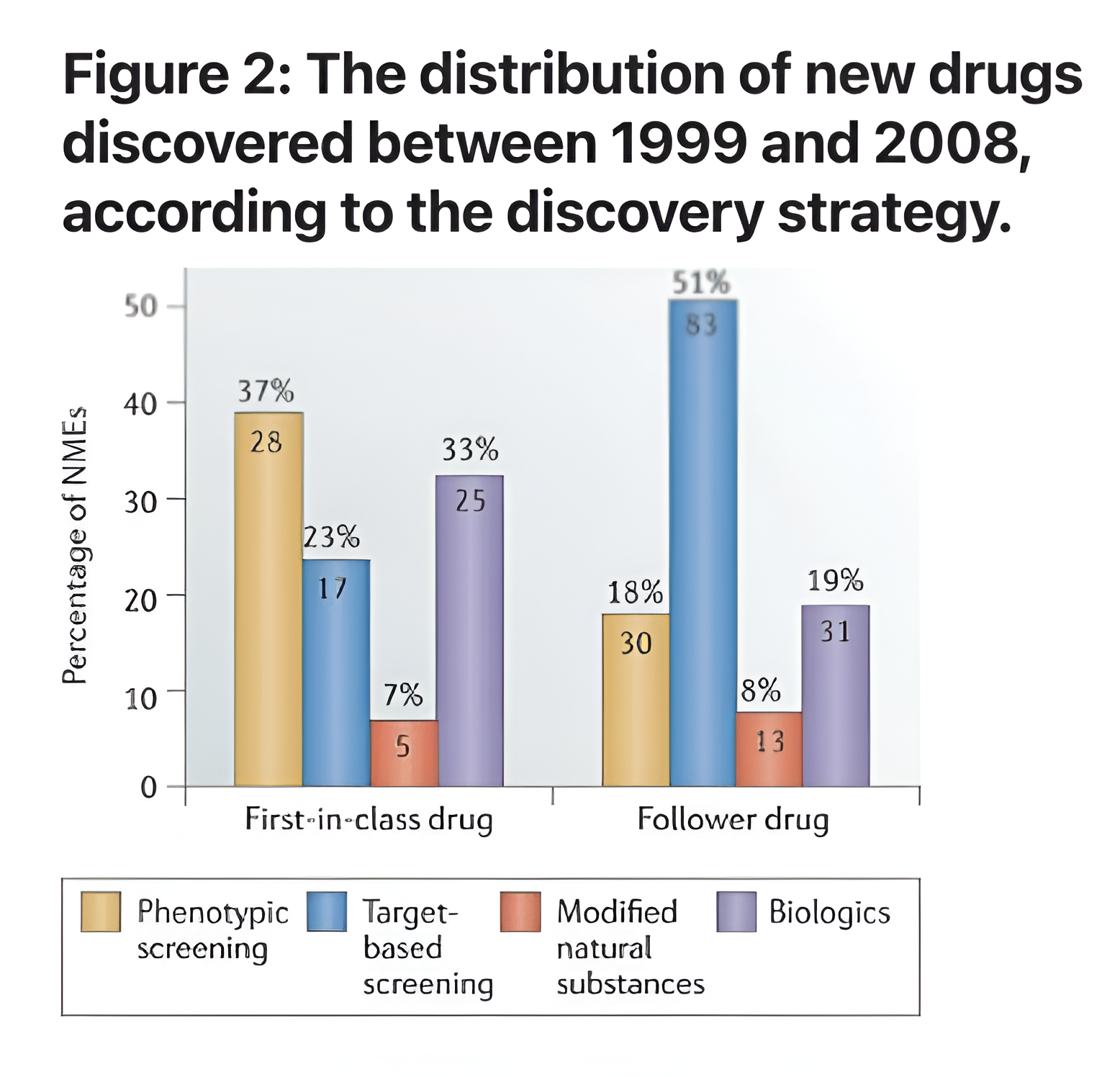
Taken from2: Swinney, D., Anthony, J. How were new medicines discovered?. Nat Rev Drug Discov 10, 507–519 (2011). https://doi.org/10.1038/nrd3480
Drug Repurposing: Building on What We Already Know
Drug repurposing (also called repositioning) identifies new therapeutic uses for existing drugs or candidates. By leveraging the safety, tolerability, and drug-like-property knowledge already accumulated, it can shortcut much of the preclinical and early-phase work and largely eliminate the attrition from unexpected safety findings.
Melior Discovery, founded in January 2005, was one of the earliest companies dedicated to this strategy, combining both ideas into a single differentiated approach: apply a high-quality in vivo phenotypic platform to high-value repositioning candidates.
theraTRACE®: A High-Information Approach to Phenotypic Screening
theraTRACE® is that platform, a multiplexed in vivo battery of roughly 40 animal models of disease, validated to run together on shared cohorts without interfering with one another. The payoff is efficiency without loss of information: evaluating one test article across three doses uses ~400 mice versus the ~1,600 fully independent studies would require, with a full screen in about eight weeks. The models span metabolic disease, inflammation, neurodegeneration, neuropsychiatry, pain, gastrointestinal, cardiovascular, dermatology, and more.
The logic of choosing in vivo over less expensive cell-based methods rests on the substrate. Melior largely screens discontinued clinical-stage and late-preclinical compounds, assets with tens of millions of dollars already invested and proven human safety. The pool of such “privileged” compounds is small: hundreds, or a few thousand, not tens of thousands. When your substrate is that valuable and scarce, predictive quality matters far more than throughput. Missing a real new indication is the expensive outcome.
Low Risk, High Reward: The Strategic Case for In Vivo Phenotypic Screening
Phenotypic screening and drug repurposing become particularly compelling when applied to compounds with substantial prior development histories.
Repurposing starts with an asset for which important questions may already have answers. Phenotypic screening then expands the search beyond the indications and mechanisms that originally defined the compound’s development path.
Together, the approaches create a potentially powerful risk-reward equation.
Known safety and pharmacology + broad biological exploration = more opportunities with less fundamental uncertainty.
Rather than starting from scratch, this strategy builds on existing investment while using biology to search for therapeutic potential that may have remained hidden.
This is particularly important for compounds that discontinued development, not because they were inherently unsafe or pharmacologically inactive, but because they may have been tested against the wrong disease, in the wrong patient population, or without sufficient understanding of the biological context in which their effects emerge. In this sense, phenotypic screening is not simply another way to screen compounds. It is a way to expand the questions we can ask of them.
See what a phenotypic screen could surface about your compound
Talk to our scientists about running your candidate through theraTRACE®.
Bringing Machine Learning to Environmental and Physiological Context Enabling Better Drug Discovery
We have all heard the hype around and investment in artificial intelligence (AI) for drug discovery but the clinical impact remains limited.
A recent perspective by Bender and colleagues3 argues that one reason is that models are often trained on data that do not adequately predict outcomes in humans. And that models should be built and judged on the translation success, not on preclinical proxy scores.
His data shows that an approximate answer to the right question beats an exact score on the wrong one.
Most published and commercial AI in small-molecule discovery sits in preclinical ligand work:
- Hit finding and virtual screening
- On-target potency / affinity
- Generative design of new structures
- Protein structure prediction (AlphaFold and follow-ons)
- Easy physicochemical proxies (logD, some in vitro ADME)
So AI should support the chain:
- The right target / biology – disease-modifying mechanism, not just a bindable protein
- The right molecule as a drug – exposure, selectivity, safety, human PK, not just IC50
- The right patient – endotypes, biomarkers, who will respond
These questions extend well beyond whether a molecule binds a target or performs well in an assay.
And this brings us back to the biology.
A whole-organism phenotypic platform generates something conventional cell-based screening generally cannot: context-rich biological data.
A compound’s effects may vary with diet, circadian timing, fasting state, temperature, strain, disease state, and other physiological conditions.
In many traditional pharmacology studies, these variables are treated primarily as sources of experimental variability to control.
But what if they are not simply noise? What if they are signal?
That distinction could become increasingly important as machine learning provides an opportunity to query the effects of many such variables across large numbers of studies.
Conclusion: From More Data to the Biologically Relevant Data
The next generation of drug discovery will not necessarily come from generating more data. It will come from generating the right data, in the right biological context, and using that information to uncover opportunities that conventional approaches cannot see.
Melior’s approach brings together three powerful ideas: the breadth of whole-organism phenotypic screening, the reduced uncertainty in drug discovery, and drug repurposing.
The premise is straightforward: the biology surrounding known targets is far richer than our current understanding suggests.
Phenotypic screening provides a way to explore that biology without requiring every mechanism to be known in advance. Drug repurposing provides a valuable starting point in compounds with existing development and safety knowledge. And machine learning creates the opportunity to learn from the complex biological context generated along the way.
The result is a fundamentally different approach to discovery: rather than asking only whether a compound works, we can begin asking where, when, why, and under what biological conditions it works.
That shift, from generating more data to generating and learning from the right data, could be one of the most important opportunities in modern drug discovery.
Phenotypic screening and drug repurposing offer a compelling low-risk, high-reward strategy for uncovering the therapeutic potential hiding in compounds we thought we already understood.
References
- Reaume, A and Lipinski, C. Why an In Vivo Screening Platform Covering Broad Therapeutic Spectrum is an Ideal Tool for Drug Repositioning: Illustrated by Discovery of a Novel Class of Insulin Sensitizers. Drug Discovery Series No. 77. Chapter 12. Royal Society of Chemistry.
https://books.rsc.org/books/edited-volume/884/chapter-abstract/666470/Why-an-In-Vivo-Screening-Platform-Covering-Broad?redirectedFrom=fulltext - Swinney, D., Anthony, J. How were new medicines discovered?. Nat Rev Drug Discov 10, 507–519 (2011). https://doi.org/10.1038/nrd3480
- Bender, A., Thomas, M.C., Scannell, J.W. et al. Artificial intelligence in drug discovery — what it is, where we stand and the path forward. Nat Rev Drug Discov (2026). https://doi.org/10.1038/s41573-026-01496-2
Frequently Asked Questions
Melior Discovery is a US-based in vivo pharmacology CRO and a recognized leader in drug repositioning (drug repurposing). Its proprietary theraTRACE® platform screens a single compound across roughly 40 validated in vivo disease models spanning 14 therapeutic areas to systematically uncover new therapeutic indications for existing and development-stage compounds.
Drug repositioning, also called drug repurposing, is the process of identifying a new therapeutic indication for an existing drug, a discontinued clinical candidate, or a shelved preclinical compound. Because these assets already have established safety, pharmacology, and manufacturing data, repurposing can reach new indications faster and at lower cost and risk than developing a new molecule from scratch.
In vivo phenotypic screening evaluates a compound by its effect on whole living disease models rather than against a single predefined molecular target. This mechanism-unbiased approach can surface unexpected therapeutic activity — new indications the development team would not have hypothesized — making it one of the most powerful tools for drug repurposing.
A specialized drug repurposing CRO brings validated in vivo models, mechanism-unbiased screening methodology, and the scientific expertise to interpret unexpected signals and design credible confirmatory studies. For a company holding a stalled but valuable asset, the right partner can convert prior investment into a defined new development path rather than a write-off.
Ideal candidates are typically “privileged” assets, compounds that advanced into or through clinical development before being discontinued for reasons other than safety, and that already carry substantial pharmacology and investment. Alternatively, candidates that act on novel targets where the biology is not yet well-explored are also good drug repurposing candidates.
 Interested in conducting a preclinical efficacy study with your therapeutic candidate?
If you are interested in learning more about Melior’s preclinical efficacy study services, please contact us to start the conversation today!