


theraTRACE® Phenotypic Screening
How to Best Identify Unpredicted New Uses of an Existing Compound
The Ideal Repositioning Candidates
The archetypal case of drug repositioning, with a discontinued clinical-stage candidate or late-stage preclinical compound, involves working with a “privileged” asset where typically tens of millions of dollars and years of research have been invested. The pharmacopoeia of ideal drug repositioning candidates measures in the hundreds, not the thousands or tens of thousands.
The Ideal Tool Given the Ideal Candidates
Therefore, the ideal screening tool for identifying otherwise unpredicted new uses does not need to be high throughput so much as it needs to be high quality – capable of accurately identifying new biology associated with a given candidate.The highest quality preclinical tool for predicting clinical outcome is an animal model. This is the philosophy with which Melior approaches drug repositioning screens.
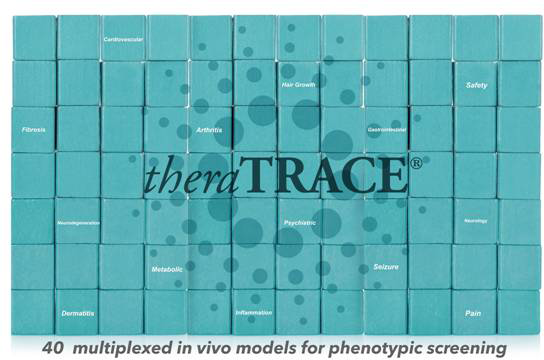
theraTRACE® is Designed as the Ideal Platform for Drug Repositioning
Our theraTRACE® phenotypic screening platform provides a high quality and cost-effective means of identifying drug repositioning/repurposing opportunities through a broad array of in vivo models of disease in different therapeutic areas.
Melior’s standard platform is designed to evaluate compounds across a wide therapeutic spectrum in an unbiased fashion (i.e. this is a non-hypothesis-driven approach). By evaluating compounds through approximately 40 different animal models representing 14 broad therapeutic areas, Melior is able to uncover efficacy that is otherwise unpredicted and expected by other means.
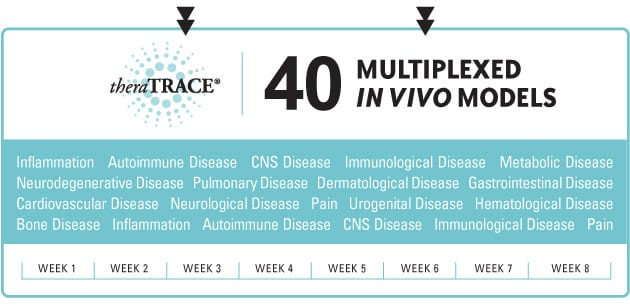
Years of experience with the models incorporated into theraTRACE® have allowed Melior to multiplex the models, thereby allowing this work to be done for a fraction of the cost compared to running the models independent of one another, yet without compromising the quality of the models in any way. Typically, one or more compounds can be evaluated across a full suite of 40 models in about 10 weeks.
Melior offers access to our theraTRACE® platform as contract research or on a collaborative research basis. We are a dedicated in vivo pharmacology CRO that strives to provide the highest quality service.
If you are interested in learning more about the theraTRACE® phenotypic screening platform, please contact [email protected] to start the conversation.




 Interested in learning more about theraTRACE®?
If you are interested in learning more about phenotypic screening and drug repositioning, please contact us to start the conversation today!
Frequently Asked Questions
theraTRACE® is Melior’s proprietary in vivo phenotypic screening platform. It runs a single compound through a broad panel of validated animal disease models in parallel, revealing biological activity the compound was never designed to produce. Rather than testing one hypothesis at a time, theraTRACE® asks an open question — what does this molecule actually do across a range of disease states — and lets the biology answer. The multiplexed design substantially reduces the animals, test article, and staff time required compared with running the same models sequentially, without compromising the quality of any individual model.
theraTRACE® is ideal for clinical-stage failures, shelved drug assets, and discovery-stage compounds. Whether you’re looking to identify a new indication for an existing molecule or select the best indication for a novel therapy, the platform helps uncover new therapeutic opportunities.
Yes, and it’s among the strongest applications of the platform. A clinical failure is usually an indication failure, not a molecule failure — the compound did something, just not the thing it was being measured against. Because the safety and PK work is already complete, a repositioned candidate can re-enter development at a much later stage than a new molecule, with correspondingly lower cost and risk. theraTRACE® identifies where the compound’s real activity lies so that redevelopment targets an indication the biology actually supports.
Shelved compounds are often the most efficient starting point of all. They’re typically well-characterized, already synthesized, and unencumbered by an active program — meaning no competing internal priorities and a clean decision path if something is found. theraTRACE® can evaluate them without new chemistry or reformulation, converting a dormant asset into either a new development candidate or a partnering and out-licensing opportunity.
Yes. Discovery screening through theraTRACE® evaluates novel compounds across a broad disease panel before an indication is locked in. This surfaces activity a target-directed program would never look for, and it de-risks the indication decision itself — the point in development where a wrong choice is most expensive and least reversible. It also generates a broader pharmacological profile of the molecule, which is useful for both development strategy and IP positioning.
Across hundreds of compounds screened, approximately one in three has presented with a potential new indication. That rate is consistent with published literature on off-label prescribing patterns (Radley, Finkelstein & Stafford, Archives of Internal Medicine, 2006), which found substantial clinical use of approved drugs outside their labeled indications — an independent signal that most compounds carry untapped therapeutic activity.
Generally no. Roughly 90% of newly uncovered indications in Melior’s experience are on-target effects, the compound is acting through the target it was optimized for, in a disease context nobody had tested. That means the medicinal chemistry work is already done and the molecule can move forward as-is, rather than becoming the starting point for a new optimization campaign.
An individual compound analysis typically runs 8–10 weeks, depending on whether PK and dose-finding studies are performed first. A typical engagement of 10–20 compounds is generally completed within six months of compound receipt.
Substantially less than running the equivalent models independently — reducing test article requirements is a core design feature of the multiplexed approach, which matters most for compounds where resynthesis is expensive or the remaining supply is finite. Exact quantities depend on the panel and dosing regimen, and are defined during study design.
Each engagement is scoped individually during study design, based on the disease-model panel, dosing regimen, group sizes, and any PK or dose-finding work performed first. Most programs begin as a defined pilot project rather than a long-term commitment, so you can start with a focused study and expand only if the data warrants it. Melior’s scientists work with you to build a design that fits your questions, timeline, and budget before any work begins.
Yes. MLR-1023 (tolimidone) was identified through theraTRACE® as having unexpected antidiabetic activity, later characterized as a novel Lyn kinase activator and insulin sensitizer, and advanced to clinical proof of concept. The discovery is published in Bioorganic & Medicinal Chemistry, with the translational case in Drug Discovery Today: Therapeutic Strategies.
Clients receive a complete data package: study design documentation specifying models, endpoints, dosing, and group sizes; raw and analyzed data; written scientific documentation from the Melior scientists who designed and ran the work. Where reference compounds were included, comparative benchmarking data is provided alongside the test article results.
