


6-Hz Psychomotor Seizure Model
Screen anticonvulsants for therapy-resistant partial seizures
Assess a compound’s ability to inhibit psychomotor seizure activity in Melior’s 6 Hz seizure model, a focal-seizure assay validated with valproate and built to surface anticonvulsants effective against therapy-resistant seizures.
A Validated 6 Hz Seizure Model for Therapy-Resistant Epilepsy Screening
Epilepsy affects millions of people, and many are not controlled by the anticonvulsants on the market today, so there is a persistent need for agents that work where existing drugs fail.
The 6 Hz seizure model produces a psychomotor seizure through low-frequency corneal stimulation. This partial, focal seizure makes the model a valuable complement to generalized models such as MES and PTZ, and at higher currents it screens for pharmacoresistant, therapy-resistant seizures.
Melior runs the 6 Hz seizure model to detect anticonvulsants active against therapy-resistant partial seizures, with adjustable stimulation across 22, 32, and 44 mA and graded 1–3 seizure severity scoring, giving drug developers a flexible, translationally relevant readout.
Why Researchers Choose Melior’s 6-Hz Psychomotor Seizure Model
- Detects therapy-resistant seizures. The 6 Hz seizure model captures partial psychomotor seizure activity that generalized models can miss, and at higher currents it screens for anticonvulsants active against pharmacoresistant epilepsy.
- Graded seizure scoring. Beyond simple presence or absence, Melior scores seizure severity on a 1–3 scale, with a higher score indicating more serious activity.
- Adjustable stimulation intensity. Clients can select a single current or run several (22, 32, and 44 mA) and apply different stimuli to different groups.
- Efficacy paired with tolerability. Add Irwin or open field assessment to separate true anticonvulsant effect from sedation.
This model is 1 of more than 60 models included in our theraTRACE® platform
Ready to get started or looking for a custom model?
Contact us today for more information about our bespoke research models and to discuss how we can help you answer your unique research questions.
Interested in running a 6-Hz Psychomotor Seizure study?
If you are interested in learning more about the 6-Hz Psychomotor Seizure model, please contact us to start the conversation today!





6-Hz Psychomotor Seizure
Weighted seizure scores were calculated using the following values for different types of seizure activity:
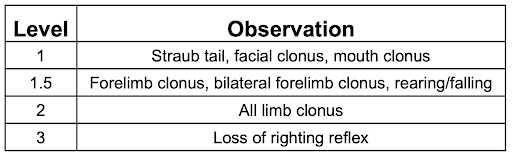
Figure 1. For each animal, counts of each level of seizure activity were summed and multiplied by the respective weighting factor to produce a total weighted seizure score.

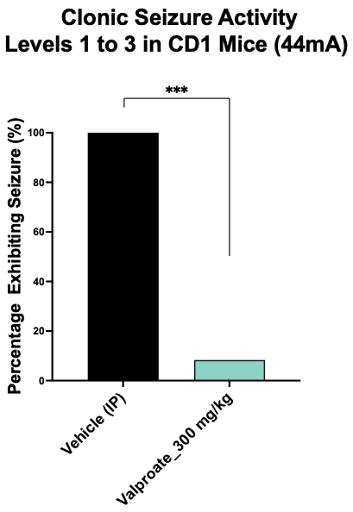
Figure 2: Clonic Seizure Incidence at 32mA and 44mA, Levels 1-3. ICR-CD1 mice were treated with either vehicle or Valproate (IP, 300 mg/kg) fifteen minutes prior to seizure induction by 6 Hz corneal stimulation at a current of 32mA or 44mA. The mice were observed for biting and clonus seizure activity displayed within 20 seconds of shock administration. In addition all seizure activity on a scaling system were noted and used to calculate weighted seizure scores for each group to quantify the level of seizure activity.
Percentage of animals in each group displaying Level 1, 2, or 3 seizure activity. Level 1 includes: Straub tail, facial or mouth clonus; Level 1.5 includes forelimb, bilateral forelimb, or rearing/falling; Level 2 includes all limb clonus; Level 3 includes loss of righting reflex. The percentage of animals displaying seizure activity Levels 1-3 was significantly reduced in the Valproate treatment group. Data are mean ± SEM, 20 second time-out; *p<0.05, ** p<0.01, *** p<0.001, **** p<0.0001 compared to vehicle.
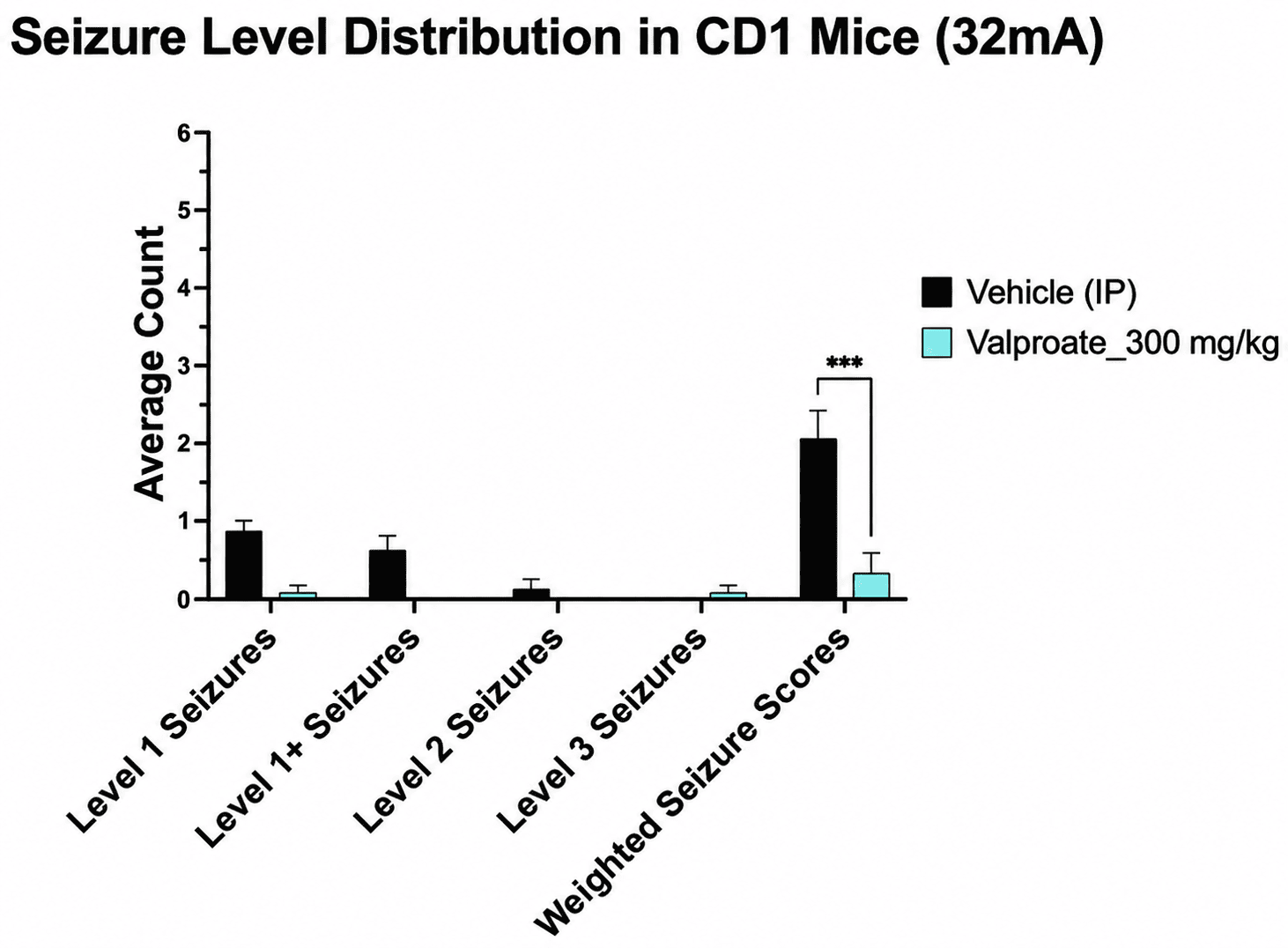
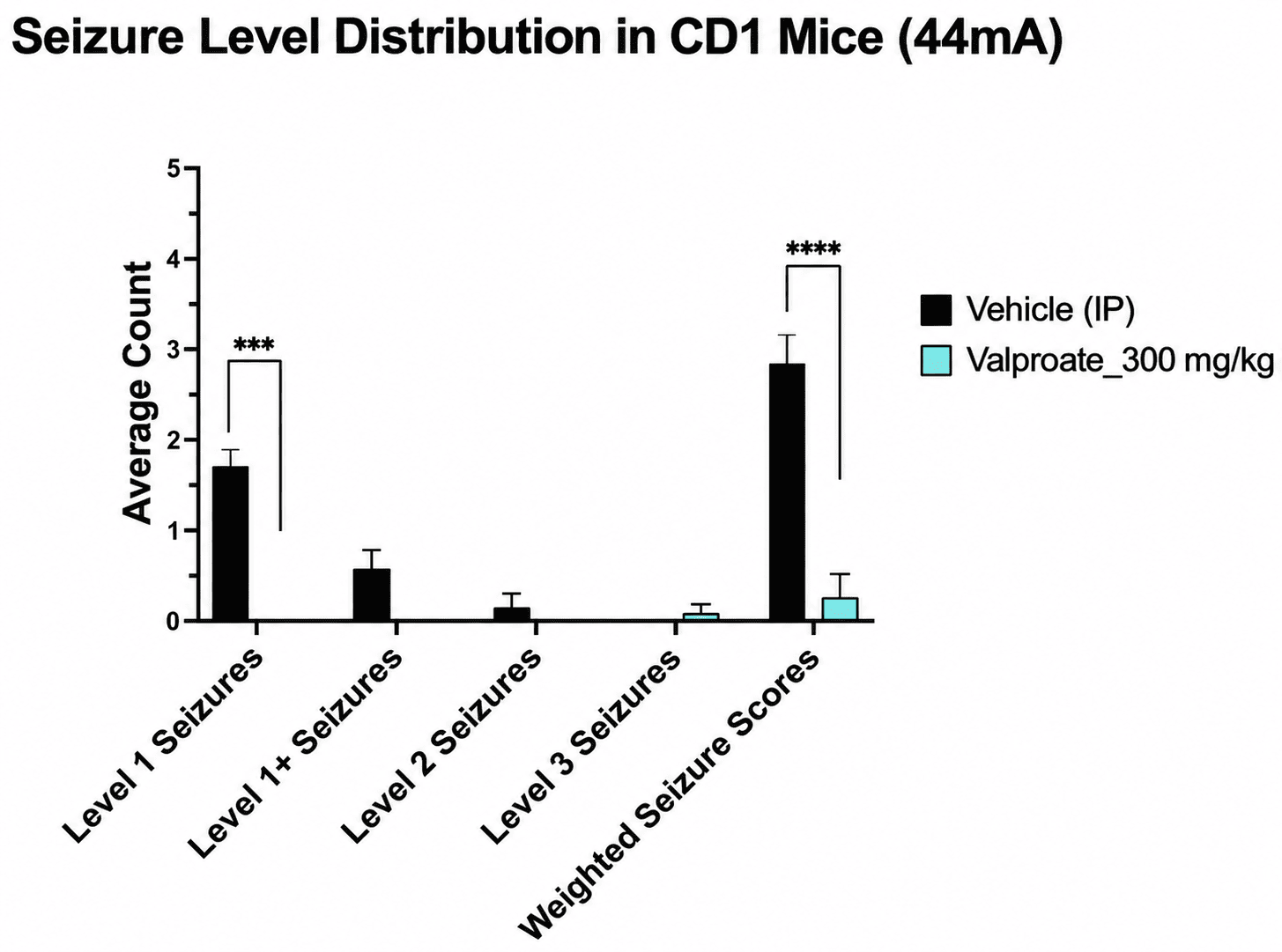
Figure 3: Seizure Level Distribution and Weighted Seizure Scores at 32mA and 44mA. ICR-CD1 mice were treated with either vehicle or Valproate (IP, 300 mg/kg) fifteen minutes prior to seizure induction by 6 Hz corneal stimulation at a current of 32mA or 44mA. The mice were observed for biting and clonus seizure activity displayed within 20 seconds of shock administration. In addition all seizure activity on a scaling system were noted and used to calculate weighted seizure scores for each group to quantify the level of seizure activity.
Average count of clonic seizure activity, level 1, 1+, 2, or 3 from each group. Level 1 includes: straub tail, facial or mouth clonus; Level 1.5 includes: forelimb, bilateral forelimb, or rearing/falling; Level 2 includes all limb clonus; Level 3 includes loss of righting reflex. Weighted seizure score was calculated by assigning weights to seizure levels and producing an overall weighted seizure score for each animal. Valproate significantly reduced weighted seizure score at both 32 and 44mA. Valproate significantly reduced the average count of level 1 seizures at 44mA. Data are mean ± SEM, 20 second time-out; *p<0.05, ** p<0.01, *** p<0.001, **** p<0.0001 compared to vehicle.
Frequently Asked Questions
The 6 Hz seizure model measures a compound’s ability to inhibit partial, focal seizures. Low-frequency corneal stimulation produces a psychomotor seizure, and Melior records whether seizure activity occurs and scores its severity on a 1–3 scale.
MES and PTZ model generalized seizures, while the 6 Hz seizure model captures partial psychomotor seizure activity and, at higher currents, therapy-resistant seizures. Running it alongside MES and PTZ profiles a candidate across seizure types.
Standard testing uses 22, 32, and 44 mA. The current can be adjusted, and different groups can receive different stimuli, so higher intensities can probe pharmacoresistant seizures.
A standard 6 Hz seizure model study runs roughly 3 to 4 weeks: animal acclimation (week 1), testing (week 2), data analysis (week 3), and reporting (week 4).
Yes. Dosing regimens, comparator or reference compounds, stimulation current, and the seizure-scoring readout can all be customized to your program.
Citations
1. Hashmi et al. Histopathological Evidence of Neurodegenerative Pathology in Epilepsy: A Systematic Review. Ann Clin Transl Neurol. 2025. https://doi.org/10.1002/acn3.70486
2. Barton ME, Klein BD, Wolf HH, White HS. Pharmacological characterization of the 6 Hz psychomotor seizure model of partial epilepsy. Epilepsy Res. 2001;47(3):217–227. https://pubmed.ncbi.nlm.nih.gov/11738929/
3. Kaminski RM, Livingood MR, Rogawski MA. Allopregnanolone analogs that positively modulate GABAA receptors protect against partial seizures induced by 6-Hz electrical stimulation in mice. Epilepsia. 2004;45(7):864–867.