


ob/ob Mouse Model of Obesity and Diabetes
Discover how Melior’s unique phenotypic screening platforms can uncover the untapped value of your candidate therapeutic
Type II diabetes is characterized by high blood glucose levels, insulin resistance, ß-cell loss, as well as a predisposition towards obesity and dyslipidemia. While there are many animal models of type II diabetes that demonstrate impaired glucose challenge (see OGTT mouse model), the ob/ob mice model is a well-accepted model of type II diabetes that recapitulates many aspects of type II diabetes in humans.
Ob/ob mice express mutations in the leptin gene that lead to obesity. These mice display progressive food intake, insulin resistance and moderately increased blood glucose levels. This strain can be used to model prediabetes, and early phases of diabetes and obesity. Melior uses this model to evaluate test compound’s ability to treat the above-mentioned conditions.
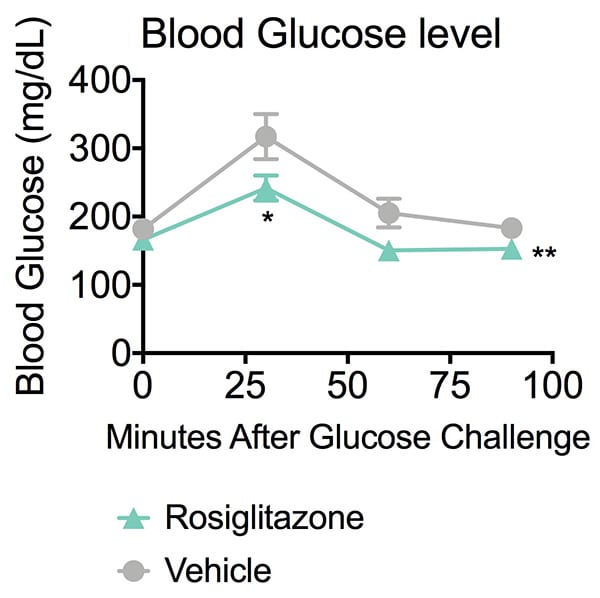
The graph illustrates the difference in response to a blood glucose challenge in ob/ob mice treated with vehicle or rosiglitazone – an insulin sensitizer and antidiabetic drug. Ob/ob mice administered rosiglitazone show significantly lower blood glucose across time relative to vehicle treated mice. Data are mean ± SEM; * p<0.05, **p<0.01 compared to vehicle (N=4-7).
The ob/ob mouse model may be used in an acute setting but is more typically used in a chronic setting to evaluate a compound’s cumulative action over several weeks of treatment. The variability if reasonably low such that good statistically significant effects are seen with validating compounds with group sizes of about 8 animals.
Frequently Asked Questions
The ob/ob mouse model is used to mimic the pre-diabete stage and overt obesity condition.
Bodyweight, food intake, insulin sensitivity and glucose tolerance are key measurements for this model.
The ob/ob mouse carries a loss-of-function mutation in the leptin gene (Lep), resulting in a complete absence of functional leptin. This model is widely used in preclinical research to study obesity, type 2 diabetes, insulin resistance, and related metabolic complications, and to evaluate the efficacy of weight loss and antidiabetic therapies.
Leptin is a hormone produced by adipose tissue that signals satiety to the hypothalamus. In ob/ob mice, the absence of functional leptin means this signal is never sent, causing the animals to continuously overeat (hyperphagia) and expend less energy. The resulting chronic energy imbalance drives progressive, severe obesity.
ob/ob mice develop severe obesity, hyperglycemia, hyperinsulinemia, insulin resistance, hyperlipidemia, and hypothermia. They are infertile and exhibit reduced physical activity. Metabolic dysfunction typically manifests by 4–6 weeks of age and progressively worsens, making these mice a well-characterized model for obesity-driven metabolic disease. Unlike db/db mice, their phenotype can be reversed by exogenous leptin administration.
 Interested in running a Diabetes Model study?
If you are interested in learning more about the ob/ob Mouse Model of Type II Diabetes, please contact us to start the conversation today!